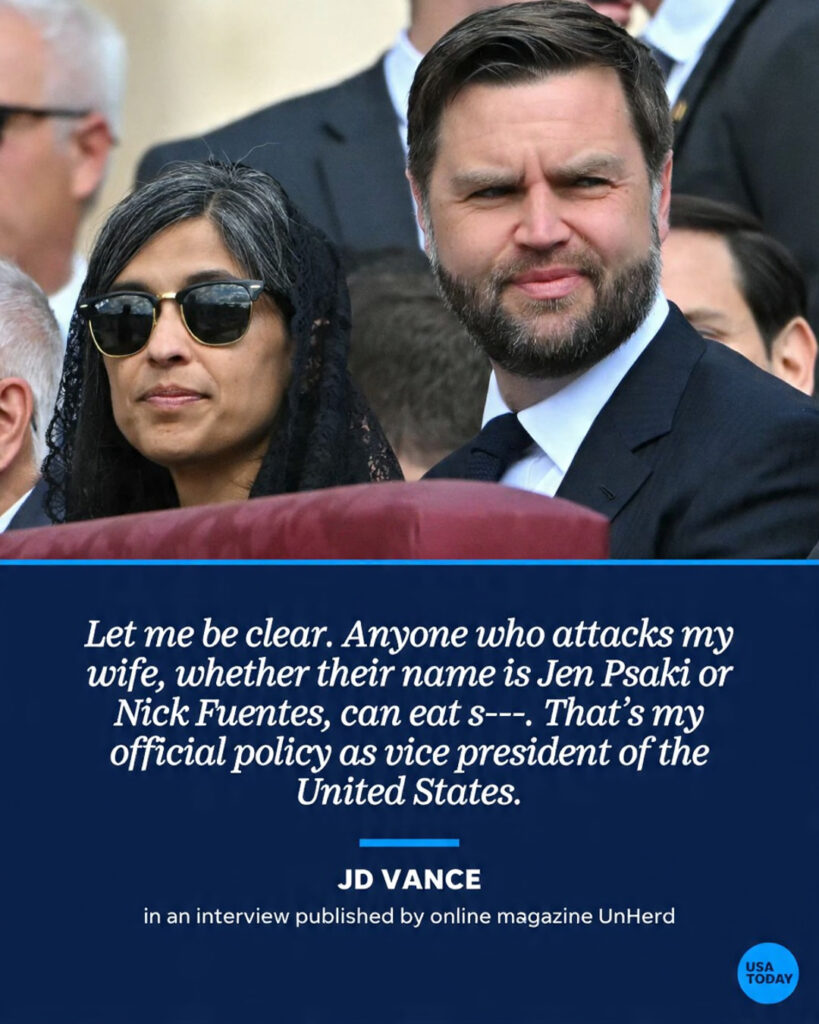
Vice President JD Vance publicly denounced political activist Nick Fuentes over the weekend following a series of derogatory remarks aimed at his wife, Usha Vance. The comments, delivered during one of Fuentes’ online livestreams, sparked swift backlash across the political spectrum and renewed debate over the normalization of extremist language in American political discourse.
Fuentes, a far-right internet figure who has been repeatedly condemned by civil rights organizations, used an ethnic slur to describe Usha Vance, who is Indian American and comes from a Hindu family. During the same broadcast, he referred to the vice president as a “race traitor,” language that critics say reflects long-standing white nationalist ideology. The Anti-Defamation League has previously characterized Fuentes as a white supremacist and has documented his history of antisemitic, racist, and extremist statements.
In a forceful response, Vice President Vance rejected the remarks outright, framing them as an attack not only on his family but on the broader principles of decency and pluralism. According to individuals familiar with his reaction, Vance viewed the comments as emblematic of a toxic strain of politics that relies on dehumanization rather than debate. Allies of the vice president said he was particularly angered by the targeting of his wife’s heritage and faith, which they described as crossing a clear moral line.
Usha Vance, an accomplished attorney and former Supreme Court clerk, has largely remained out of the political spotlight despite her husband’s rise to national office. Friends and colleagues have described her as deeply private, civic-minded, and focused on family life. The attack, however, thrust her into the center of a political storm that underscores the personal toll of public service in an era of heightened polarization.
The incident also revived attention to controversial remarks made earlier by Jen Psaki, who served as White House press secretary under President Joe Biden. In October, Psaki suggested during an on-air segment that the second lady needed to be “rescued” from her husband. “I always wonder what’s going on in the mind of his wife,” Psaki said at the time. “Like, are you OK? Please blink four times. Come over here, we’ll save you.”
Those remarks, made on her current program on MSNBC, drew criticism from conservatives and some nonpartisan observers, who argued that they were patronizing and inappropriate. Critics said the comments reduced Usha Vance to a political prop rather than acknowledging her autonomy and professional accomplishments.
Supporters of the vice president argue that the combination of Fuentes’s racial slurs and Psaki’s earlier comments highlights a troubling pattern: public figures on opposite ends of the political spectrum engaging in rhetoric that targets family members rather than policy positions. “Disagree with JD Vance all you want,” said one Republican strategist, “but dragging his wife into it—especially in racial or demeaning terms—should be off-limits.”
Civil rights advocates echoed that sentiment, warning that language rooted in racism or dehumanization can have real-world consequences. The ADL noted that such rhetoric often fuels online harassment and can escalate into threats or violence, particularly against women and minorities connected to public officials.
As the controversy continues to reverberate, the White House has not indicated whether additional security measures will be taken for the second family. For now, the episode serves as a stark reminder of how quickly political disagreement can spill into personal attacks—and of the challenges facing leaders who must navigate public life while protecting their families from the harshest edges of modern politics.