
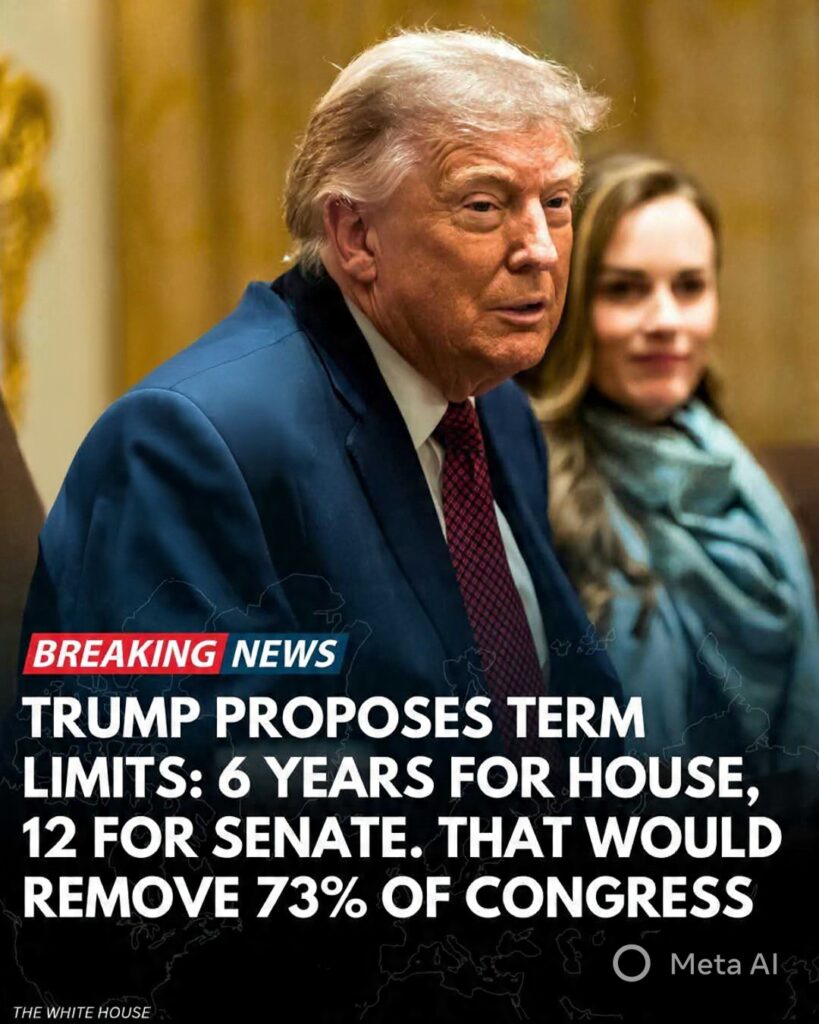
Former President Donald Trump is once again calling for a major shake-up in Washington, this time by proposing strict term limits for members of Congress. The idea, while not new, has resurfaced with renewed intensity and is already fueling debate across the political spectrum.
Under Trump’s proposal, members of the U.S. House of Representatives would be limited to six years in office—equivalent to three two-year terms—while U.S. Senators would face a twelve-year cap, or two full terms. If such limits were put in place immediately, analysts estimate that roughly 73 percent of current lawmakers would be ineligible to continue serving, dramatically altering the makeup of Congress.
“It’s about draining the swamp,” Trump has argued in the past, framing term limits as a way to curb corruption and reduce the influence of what he often calls “career politicians.” According to Trump and his supporters, lawmakers who spend decades in Washington become disconnected from everyday Americans and too closely tied to special interests, lobbyists, and party power structures.
Supporters: “Fresh Faces, New Ideas”
Supporters of the proposal say term limits would restore accountability and bring fresh energy into a system many voters view as stagnant.
“Congress was never meant to be a lifetime job,” said one conservative activist familiar with the proposal. “New leaders with real-world experience would rotate in, serve the people, and then go back home.”
Polling over the years has consistently shown that term limits are popular with voters, including many independents and Democrats, even if lawmakers themselves are less enthusiastic. Advocates argue that limits could reduce entrenched power, break up long-standing political alliances, and make Congress more responsive to voters rather than donors.
Critics: Experience Matters
Critics, however, warn that term limits could create new problems without solving the old ones.
Opponents argue that limiting how long lawmakers can serve may weaken Congress by pushing out experienced legislators who understand complex policy areas such as national security, healthcare, and the federal budget. They also warn that inexperienced lawmakers could become more dependent on unelected staffers, bureaucrats, and lobbyists—ironically increasing the influence of the very forces term limits are meant to curb.
“There’s a difference between career politicians and experienced public servants,” said a former congressional aide. “Experience can be a safeguard, not a liability.”
Some constitutional scholars also note that implementing term limits for Congress would require a constitutional amendment, a process that demands approval by two-thirds of both chambers of Congress and ratification by three-fourths of the states—a steep political hurdle.
A Debate That Won’t Go Away
Trump’s renewed push has reignited long-standing questions about how to reform Washington and rebuild public trust in government. While term limits alone may not address deeper issues like campaign finance, partisan polarization, or lobbying power, the proposal has once again forced lawmakers and voters alike to confront an uncomfortable reality: confidence in Congress remains historically low.
Whether Trump’s plan ever becomes law is uncertain. But one thing is clear—the conversation about who serves, how long they serve, and who they ultimately serve is far from over.
As Washington braces for yet another round of reform debates, Trump’s proposal has ensured that term limits are back at the center of America’s political conversation.