Washington, D.C.
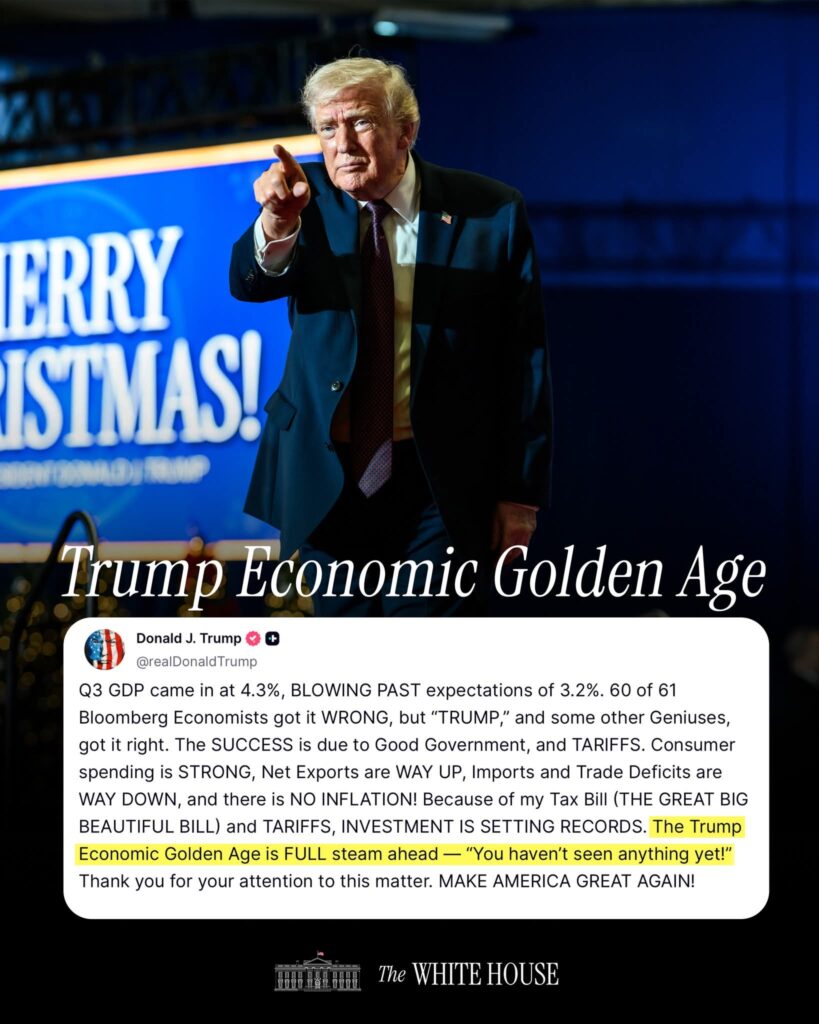
President Donald J. Trump is once again touting what he calls a renewed “Economic Golden Age” for the United States, pointing to strong consumer spending, improving trade figures, and easing inflation pressures as evidence that the economy is moving “full steam ahead.”
In a recent statement, Trump said, “Consumer spending is STRONG, Net Exports are WAY UP, Imports and Trade Deficits are WAY DOWN, and there is NO INFLATION! … You haven’t seen anything yet!” The remarks reflect the administration’s broader message that its economic agenda—centered on domestic production, trade enforcement, and deregulation—is delivering measurable results.
Consumer Spending Remains a Key Driver
According to data from the U.S. Bureau of Economic Analysis (BEA), consumer spending continues to be the backbone of the American economy, accounting for roughly two-thirds of gross domestic product (GDP). Recent quarterly reports show household spending growing at a steady pace, supported by a resilient labor market and rising wages in several sectors, particularly construction, energy, and manufacturing.
Retail sales data from the U.S. Census Bureau also indicate consistent consumer demand, especially for durable goods and services. Economists note that while higher interest rates have cooled some big-ticket purchases, everyday spending has remained solid, signaling continued confidence among American households.
Trade Balance Shows Signs of Improvement
One of the administration’s central economic goals has been reducing the U.S. trade deficit. Government trade data show that net exports have improved compared to previous years, driven by increased energy exports, agricultural shipments, and a slowdown in import growth.
The United States has expanded exports of liquefied natural gas (LNG), petroleum products, and refined fuels, benefiting from strong global demand and expanded domestic production. At the same time, imports have moderated as domestic manufacturing output increases and companies reshore portions of their supply chains.
Trade analysts caution that deficits naturally fluctuate due to currency values and global demand, but acknowledge that recent trends point to a narrower gap than in several past periods.
Inflation Pressures Have Eased
Inflation, a major concern for American families in recent years, has shown signs of cooling. Data from the Bureau of Labor Statistics (BLS) indicate that price increases have slowed compared to earlier peaks, particularly in energy and goods categories.
While inflation has not disappeared entirely, economists generally agree that the pace of price growth has moderated. Energy prices, a major driver of inflation volatility, have stabilized relative to prior spikes, helping ease costs for transportation and manufacturing.
Administration officials credit increased domestic energy production and supply-side policies for helping bring prices under control. Critics argue that inflation trends are also influenced by Federal Reserve monetary policy and global economic conditions.
Jobs and Wages Remain Central to the Debate
Employment figures continue to show low unemployment by historical standards, with job creation spread across multiple industries. Wage growth has outpaced inflation in several recent reports, improving real purchasing power for many workers.
Supporters of Trump’s economic approach argue that deregulation, tax policy, and a tougher stance on trade have contributed to job growth and rising incomes. Critics counter that economic gains have been uneven and warn about long-term fiscal pressures, including federal deficits and interest costs.
Looking Ahead
As the administration highlights positive indicators, economists urge a balanced view. Strong consumer spending and improving trade data are encouraging signs, but challenges remain, including global economic uncertainty, geopolitical risks, and the need to sustain growth without reigniting inflation.
Still, Trump’s message is clear: he believes the U.S. economy is entering a period of renewed strength. Whether this momentum continues will depend on policy decisions, global markets, and the confidence of American consumers and businesses in the months ahead.
Most recent
More