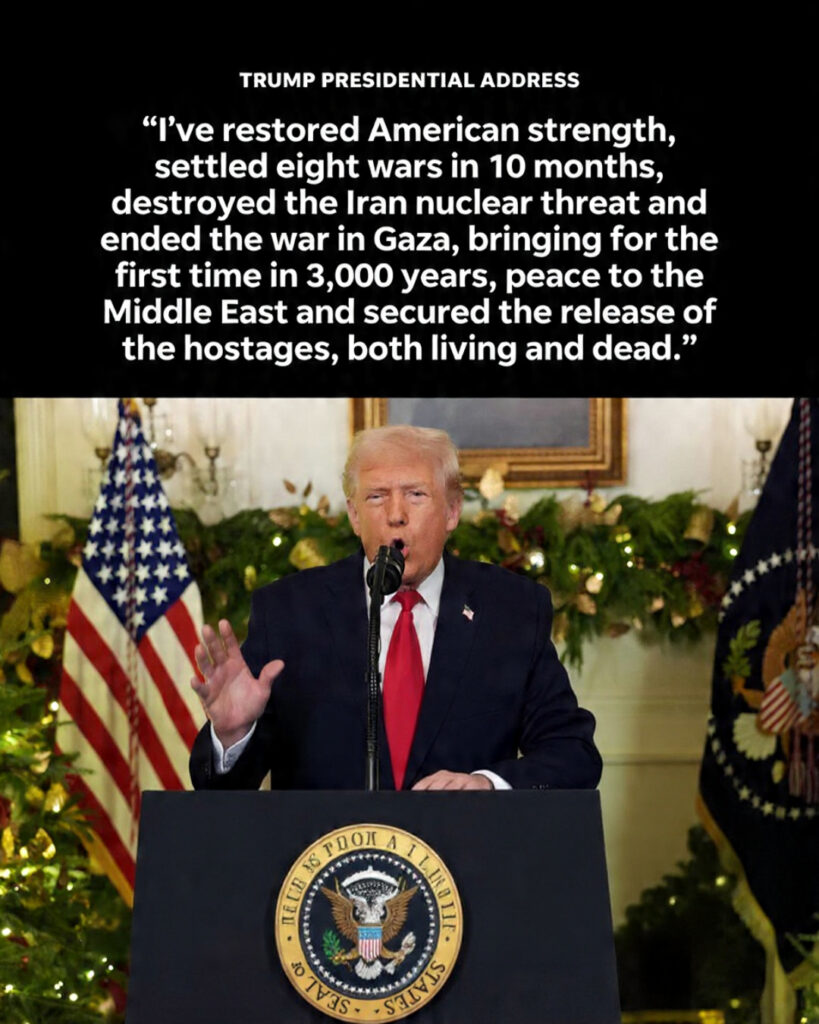
President Donald Trump used a rare primetime address from the White House this week to mount a forceful defense of his first year back in office, placing the blame for Americans’ ongoing affordability concerns squarely on Democrats, while arguing that his administration is steadily turning the economy around. The speech, delivered from the Diplomatic Reception Room amid Christmas décor, was tightly scripted, under 20 minutes long, and clearly aimed at shaping the political narrative heading into the 2026 midterm elections.
“Boy, are we making progress,” Trump said early in the address, repeating a line that became the central refrain of the night. The president framed rising costs for everyday necessities as a problem he inherited, insisting that the roots of today’s affordability crisis lie in policies enacted under the previous administration. Trump mentioned Biden repeatedly, describing the economy he took over as “a mess” and arguing that millions of Americans were priced out of basic goods and services before his return to the White House.
The timing of Trump’s message reflects growing political pressure. Recent polling shows public confidence in his economic leadership has weakened, with inflation ticking back up to around 3% and unemployment rising to 4.6% in November, the highest level in more than three years. In one December national poll, just over a third of respondents approved of Trump’s handling of the economy. Those numbers underscore why affordability has become the administration’s most significant vulnerability and a central theme for Democrats heading into next year’s elections.
Rather than sidestep the issue, Trump confronted it head-on, while redirecting responsibility. He argued that the word “affordability” only entered the national conversation under Democratic leadership and accused his political opponents of mismanaging trade, border security, and crime. In sweeping language, Trump painted a bleak picture of the country as he inherited it, citing illegal immigration, unfair trade deals, and cultural issues as symbols of broader national decline. He insisted that America is no longer being “laughed at” on the world stage and claimed that his administration has already delivered more change in 11 months than any in modern history.
One of the few concrete policy announcements in the speech was directed at the military. Trump revealed that approximately 1.45 million U.S. service members will receive a one-time Christmas bonus of $1,776, which he dubbed a “warrior dividend.” The amount is symbolic, referencing the year 1776 and the nation’s founding. Trump said the money would come from tariff revenues and recently passed Republican-backed spending and tax legislation, adding that the payments are already being processed.
“Nobody deserves it more than our military,” Trump said, congratulating service members and their families. The announcement was met with immediate attention, though questions remain about the long-term legal footing of the tariffs that are funding the payments. The Supreme Court is expected to weigh in on the president’s emergency powers related to those tariffs, and Congress traditionally controls federal spending, leaving some uncertainty about the permanence of similar future initiatives.
Trump also attempted to strike a balance between optimism and acknowledgment of lingering challenges. While he touted lower prices compared to post-pandemic peaks, he conceded that his efforts are not yet complete. “It’s not done yet,” he said, while insisting progress is undeniable. He pointed to tax cuts, energy policy, and deregulation as drivers of future growth, and previewed what he called aggressive housing reforms planned for the coming year. At the same time, he blamed high housing costs in part on illegal immigration, arguing that mass deportations would ease demand and bring prices down.
Notably absent from the speech were several major national and international developments. Trump did not address escalating tensions involving Venezuela, despite months of aggressive rhetoric and military posturing by his administration. He also avoided mention of the war in Ukraine and recent high-profile acts of violence at home that have dominated headlines. The omissions underscored the White House’s determination to keep the focus squarely on domestic economics, even as other crises compete for public attention.
The delivery itself marked a departure from Trump’s trademark rally style. Speaking rapidly and sticking closely to the teleprompter, the president moved briskly from point to point, leaving little room for improvisation. The tone was more disciplined, though no less combative, than his campaign appearances. It was a version of Trump clearly calibrated for a national television audience rather than a cheering crowd.
Whether the address succeeded in persuading skeptical Americans remains an open question. Democrats are already signaling that affordability will remain their dominant campaign theme in 2026, arguing that Trump’s policies, particularly tariffs, have contributed to higher prices rather than relief. For now, Trump appears committed to a strategy that combines forward-looking promises with relentless attacks on his predecessor, betting that voters will ultimately credit him for improvement and blame Democrats for the pain that persists.
As his second term approaches its midpoint, the speech made one thing clear: the affordability battle will define the political landscape ahead, and Trump has no intention of accepting responsibility for a problem he insists began long before he returned to office.