
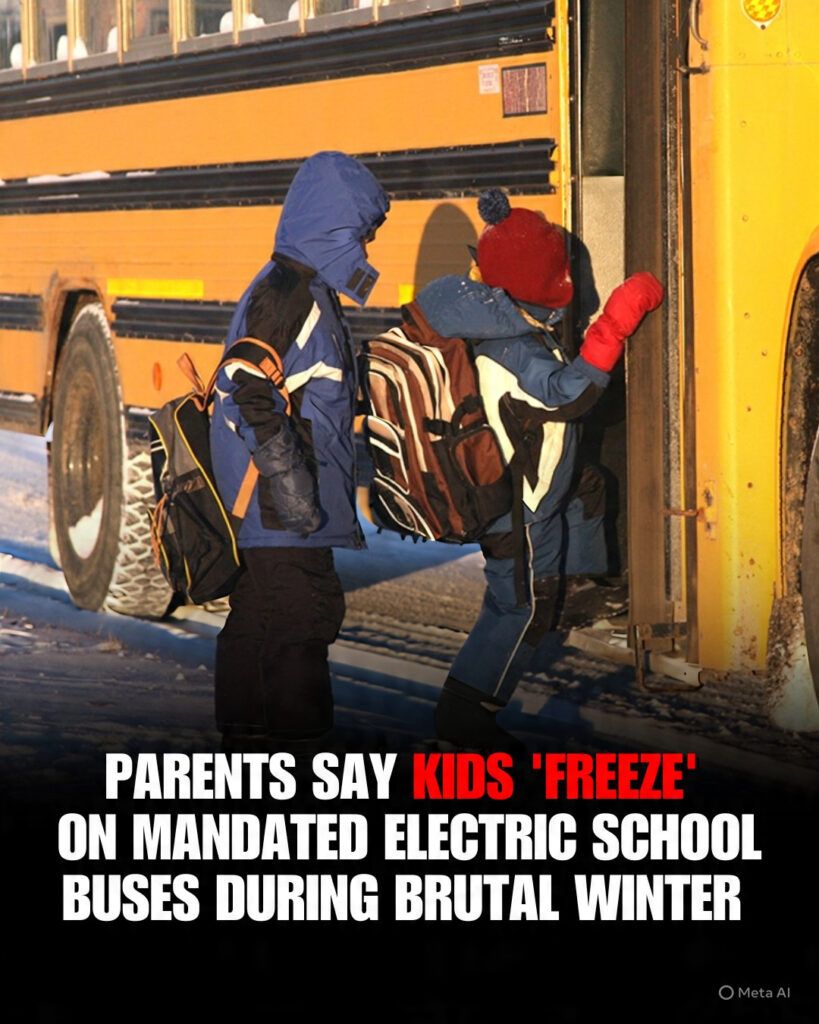
Western New York parents are raising alarms after a statewide mandate that will require all new school bus purchases to be zero-emission beginning in 2027. Families in the Lake Shore Central School District and elsewhere say electric school buses (ESBs) are arriving at the curb noticeably colder than traditional diesel buses — and that, in some cases, children are coming home shivering because cabins were not adequately heated. “He said they didn’t have heat. He came in cold, and I told him, ‘Isn’t the bus warm?’ And he said, ‘No, they can’t put the heat on because it drains the battery,’” a grandmother told local television.
New York’s transition is among the nation’s most ambitious. State policy requires that all new school buses sold in New York be zero-emission by 2027, to convert the entire fleet to electric by 2035 — a push officials say will reduce childhood exposure to diesel exhaust and cut greenhouse-gas emissions. The New York State Energy Research and Development Authority (NYSERDA) has led technical and funding efforts to support the change.
But engineers and fleet operators warn that cold weather creates real operational headaches for battery-powered buses. A Cornell University analysis of a two-year pilot found battery energy demand rose by roughly 48% in very cold conditions (about −4°C to 0°C, or 25–32°F) because propulsion and cabin/battery thermal management all draw from the same battery pack; over a broader temperature range (−12°C to 10°C, or 10–50°F) the study still saw nearly 27% higher energy consumption. That extra load translates to shorter driving range and harder choices for drivers and dispatchers: run the heater and risk cutting a route short, or limit heating to preserve battery for propulsion.
Read more: Trump Announces “Patriot Games” as Part of America’s 250th Anniversary Celebrations
Local districts say they are trying to balance comfort, safety, and route reliability. Lake Shore’s superintendent has told the media the district’s electric fleet was procured through federal funding and that buses are designed to meet transportation temperature regulations; officials say procedures require heating to be available on routes. But parents report incidents of buses being delayed for breakdowns or arriving with little or no warmth, fueling frustration and calls for changes.
The technical challenges are well documented. Independent fleet evaluations and industry groups note that heating a fully occupied bus in sub-zero weather can significantly reduce an ESB’s usable miles between charges, sometimes forcing unplanned mid-day charging or route adjustments. Operators can mitigate impacts through vehicle features such as battery thermal management systems, heat-pump cabin heaters (which are more efficient than resistive heaters), preconditioning the bus while plugged in at the depot, and larger battery packs — but those solutions add cost and infrastructure needs.
Cost and financing remain central hurdles. Analysts and some lawmakers point to sticker prices: electric school buses can cost roughly three to four times as much as a conventional diesel bus — estimates around $250,000–$350,000 per vehicle are commonly cited — and districts must invest in charging equipment and grid upgrades. The state has committed funding to smooth the transition, but critics argue that available funds and the pace of infrastructure deployment lag behind the 2027 procurement ban. One analysis of the statewide rollout noted that hundreds of millions in public dollars have been pledged, but bureaucratic delays and grant disbursement problems have slowed deliveries and charging installations.
Know more:
Fundraiser for Australian Hero Who Disarmed Terrorist at Bondi Beach Surpasses $2.6 Million
Parents, teachers, and trustees say legislators and education officials need to act quickly to prevent children from suffering in the short term while the long-term benefits of electrification take shape. Proposals include allowing flexible procurement waivers for districts that can demonstrate winter-operational risk, accelerating funding for depot chargers and battery upgrades, and requiring clearer reporting when heating is limited or unavailable on routes.
Advocates for electrification stress the public-health payoff — diesel exhaust is linked to childhood asthma and other respiratory issues — and point to technical fixes already being used by some fleets. But as New York’s cold season deepens, the debate has moved from abstract climate policy to a concrete and emotional school-bus-seat problem for families: how to keep children warm, safe, and on time while the state pushes to decarbonize student transportation.