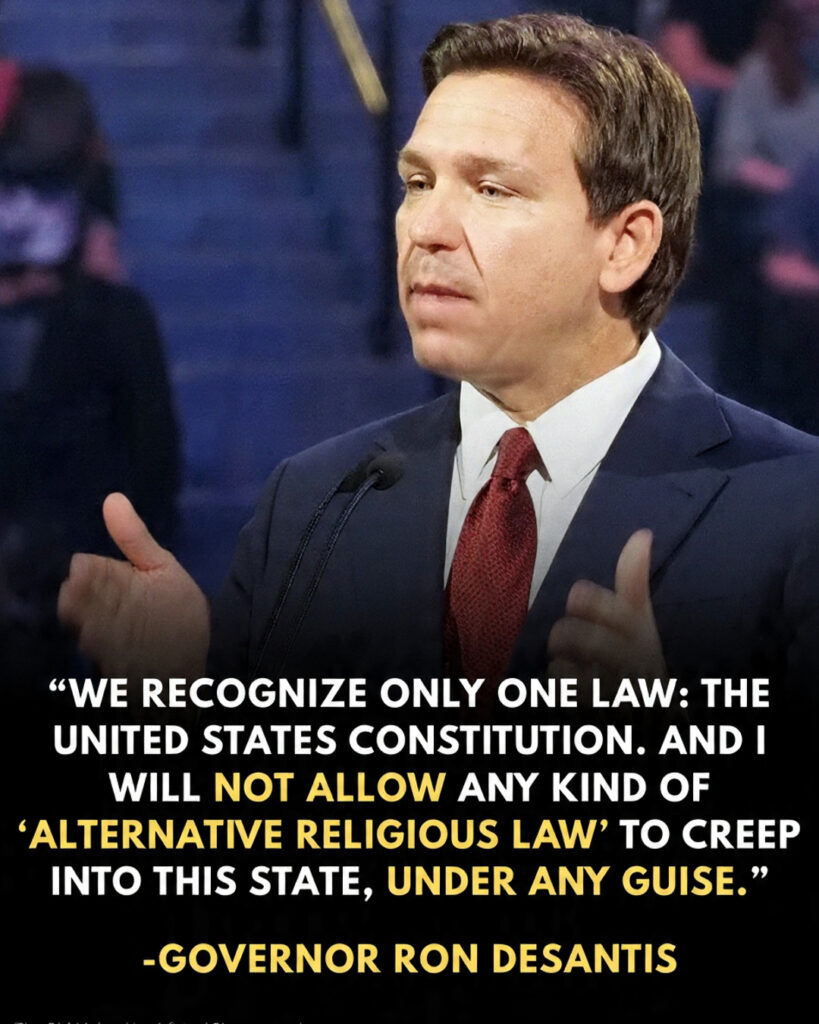
Florida Governor Ron DeSantis is once again positioning the state at the forefront of national debates over legal authority and cultural integration with the introduction of the proposed “No Shari’a Act.” The legislation seeks to bar the application or enforcement of Sharia law — or any foreign or religious legal framework — within Florida’s judicial system, reaffirming the U.S. Constitution as the state’s supreme guiding authority.
According to DeSantis, the bill is designed to protect what he describes as the “integrity and sovereignty” of Florida’s courts. Supporters of the proposal argue that it offers an added layer of assurance that no non-American legal system will be permitted to influence courtroom proceedings, family law decisions, or civil disputes. Though there is no evidence that Florida courts have ever enforced Sharia law, proponents say the legislation is a preventative measure intended to block any possibility of foreign religious systems being used as a legal reference.
The bill’s language makes clear that no religious doctrine — whether Islamic, Christian, Jewish, or otherwise — may supersede constitutional rights in matters brought before the state’s courts. By codifying this principle, DeSantis says the legislation will ensure that Florida remains “a beacon of constitutional rights, free from foreign influence or interference.”
Critics, however, argue that the bill is unnecessary and could stoke tensions by singling out a specific religion, despite its broad wording. Civil rights advocates warn that such legislation may further marginalize Muslim communities, who say the proposal feeds into misconceptions about their faith and legal traditions.
Despite the controversy, DeSantis appears determined to move forward, framing the legislation as a safeguard for Florida’s judicial independence. As the bill advances, it is expected to fuel continued debate over religious freedom, cultural diversity, and the balance between constitutional protections and political messaging in one of the nation’s most closely watched states.