
Washington, D.C.
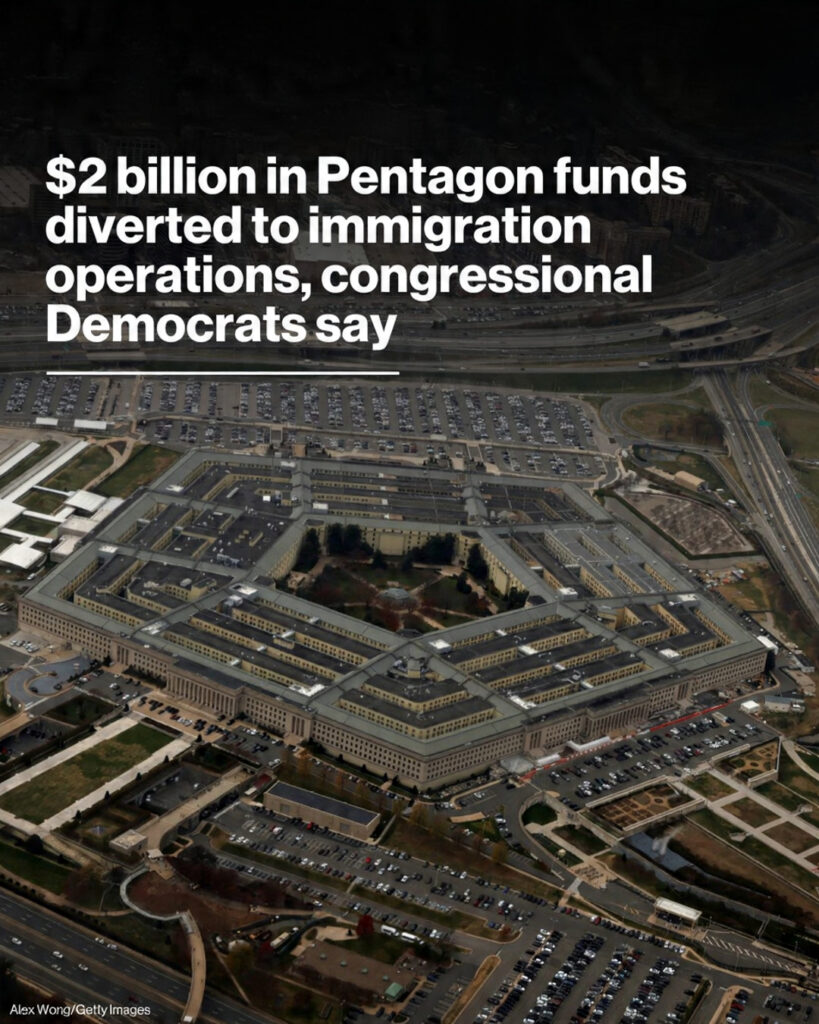
A new congressional report prepared by Democratic lawmakers alleges that the Pentagon has diverted more than $2 billion of its own funding to support the Trump administration’s immigration operations — a move they say has directly undermined U.S. military readiness and disrupted critical training exercises.
The review, compiled from publicly available data and internal reprogramming requests, found that at least $1.3 billion had been redirected to deploy active-duty troops and federalized National Guard units to the U.S.–Mexico border. An additional $420 million went toward detaining migrants at military installations in the United States and at overseas locations, including Guantanamo Bay, Cuba, and Camp Lemonnier in Djibouti.
Training Exercises Canceled or Reduced
In a written response to Sen. Elizabeth Warren (D-Mass.), General Dan Caine, chairman of the Joint Chiefs of Staff, confirmed that the diversion of personnel and funding forced the Pentagon to cancel two significant readiness exercises earlier this year:
- “Vibrant Response”, scheduled for April and May
- A 10th Mountain Division rotation at the Joint Readiness Training Center at Fort Polk, Louisiana
A third large-scale national exercise, “Ardent Sentry,” used to train military responses to chemical, biological, radiological, and nuclear threats, was “descoped,” according to Caine — meaning sharply reduced in scope.
Democratic lawmakers warned that these cancellations represent serious setbacks for preparedness. “Diverting over $2 billion in funds siphons money away from training, modernization, and maintenance,” said Rep. John Garamendi (D-Calif.). “These are core investments that support military families and ensure our forces can fight and win.”
Funding Redirected for Border Wall Construction
The report highlighted a Pentagon request in May to reprogram $200 million intended for military construction projects — including new service member housing and two Department of Defense Education Activity (DODEA) elementary schools in Kentucky and Germany — toward building a 30-foot-high steel bollard barrier near Yuma, Arizona.
This move aligns with the administration’s expanded use of the military at the border, where more than 7,000 personnel have been deployed since January of President Trump’s second term. Since April, the administration has also designated several National Defense Areas along the border, giving U.S. forces authority to temporarily detain migrants who enter restricted zones.
Costs Beyond the Border
Democrats found another $258 million spent deploying federalized Guard units and active-duty troops to U.S. cities — including Los Angeles, Chicago, Portland, and Memphis — for immigration enforcement operations.
Another $40.3 million was used to fund military flights for deportations, despite cheaper alternatives available through DHS contracts.
“This is a baffling waste of military resources,” the report stated, noting that DHS has already received $170 billion for immigration enforcement this year. Lawmakers also said there is no indication DHS intends to reimburse the Pentagon for any of the diverted funds.
Pentagon Defends Its Flexibility
The Pentagon disputed claims that readiness has suffered. Press Secretary Kingsley Wilson emphasized that the Defense Department’s nearly $1 trillion annual budget allows it to support multiple missions at once.
“Spending allocated money on one mission does not mean other missions become depleted,” Wilson said, adding that the administration’s “One Big Beautiful Bill” provided additional support for DODEA improvements and facility modernization.
Political Fallout Ahead of Senate Hearing
In a sharply worded statement, Sen. Warren accused Defense Secretary Pete Hegseth and DHS Secretary Kristi Noem of “using the defense budget as a slush fund for political stunts,” calling the diversion “an insult to our service members.”
The Senate Armed Services Committee is scheduled to question top Pentagon officials — including Gen. Gregory Guillot, head of U.S. Northern Command — about the legality and necessity of the troop deployments.
Thursday’s hearing is expected to intensify the debate over whether military resources are being stretched too thin — and whether the expanding role of U.S. forces in immigration enforcement is compromising the nation’s military preparedness.