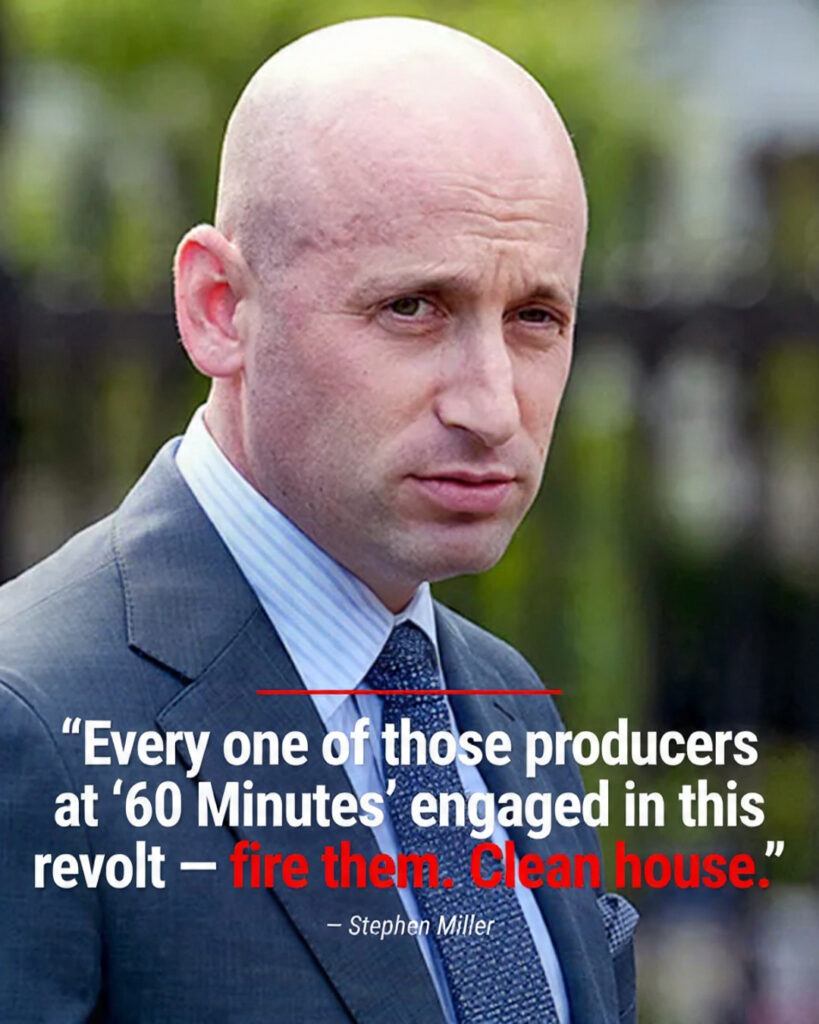
December 24, 2025 | Washington, D.C. — A political firestorm erupted this week after CBS News abruptly pulled a high-profile 60 Minutes investigative segment on the Trump administration’s deportation of migrants to a prison in El Salvador, prompting White House advisor Stephen Miller to call for a sweeping purge of the news network’s staff.
Miller — a senior adviser to President Donald Trump and one of the chief architects of the administration’s hard-line immigration policies — blasted the decision in a Tuesday night appearance, urging CBS executives to “clean house” and fire the 60 Minutes producers responsible for the shelved report. He described the segment as a “hatchet job” aimed at generating sympathy for “illegal immigrant gang members,” claiming it misrepresented the administration’s enforcement actions. Fox News+1
“Every one of those producers at 60 Minutes engaged in this revolt,” Miller said on Jesse Watters Primetime. “Fire them. Clean house. Fire them. That’s what I say.” The Daily Beast
Controversial Report on Deportations
The segment, titled “Inside CECOT,” was produced by veteran 60 Minutes correspondent Sharyn Alfonsi and focused on the experiences of Venezuelan migrants deported under a Trump-era agreement and held at El Salvador’s Terrorism Confinement Center (CECOT), a maximum-security prison. Interviews with former detainees and independent documentation portrayed conditions at the facility as brutal — including reports of beatings, torture, and sexual violence. https://www.walb.com+1
Portions of the investigation that surfaced after an accidental Canadian broadcast suggested that only a small fraction of the deported individuals had been convicted of violent crimes, corroborating findings from Human Rights Watch and ICE data reviewed by 60 Minutes.
News of the segment’s cancellation sparked intense debate about media independence and editorial interference at one of America’s most prestigious news programs.
Decision to Pull the Story
CBS News Editor-in-Chief Bari Weiss — a former opinion columnist brought in earlier this year after CBS’s parent company Paramount acquired her publication The Free Press — made the decision to pull the report just hours before its scheduled broadcast. Weiss told colleagues the story needed further reporting and on-the-record comment from administration officials before it could air. vpm.org
Alfonsi and the other 60 Minutes staff pushed back, accusing Weiss of censoring the piece for political reasons. In internal emails obtained by NPR and other outlets, Alfonsi argued the segment had already passed through multiple editorial and legal reviews, and that the pull-back appeared to be motivated by concerns over the network’s relationship with the White House. vpm.org
The 60 Minutes report had been formally reviewed and cleared by CBS’s legal and standards divisions before Weiss’s intervention, according to network staff. Weiss critics say the abrupt last-minute cancellation is unprecedented and undermines the program’s reputation for independent journalism. The Washington Post
Claims of Political Influence
The controversy has drawn attention beyond the White House. Inside CBS News, journalists and some media observers have raised concerns that editorial decisions may be influenced by political pressures or corporate interests, particularly amid Paramount’s ongoing strategic moves and regulatory scrutiny. Critics argue that withholding a major investigative story because the administration declined to comment effectively rewards silence effectively and limits accountability reporting. Straight Arrow News
Supporters of Weiss counter that enforcing rigorous standards — including securing responses from all sides — is a legitimate newsroom practice and not equivalent to censorship. Weiss has maintained that the story will air once it meets her standards for completeness and fairness. Wall Street Journal
Broader Context
The debate unfolds against the backdrop of the Trump administration’s expanded immigration enforcement, which includes large-scale deportation plans that experts have projected would cost billions of dollars annually and could dramatically reshape U.S. immigration policy. CBS News
Immigration reporting has been a flashpoint in U.S. politics for years, with advocates on all sides arguing over the balance between national security, human rights, and media responsibility. The clashing narratives around the 60 Minutes segment reflect these broader national tensions — and raise questions about the role of major news organizations in covering contentious government policies.