WASHINGTON — President Donald Trump on Thursday attributed a recent uptick in the U.S. unemployment rate to sweeping cuts to the federal workforce, arguing that the increase reflects deliberate government downsizing rather than underlying weakness in the broader economy.
Speaking to reporters, Trump said unemployment rising to 4.5% was a direct result of what he described as unprecedented reductions in government payrolls, part of his administration’s push to shrink the size of Washington and redirect economic growth toward the private sector.
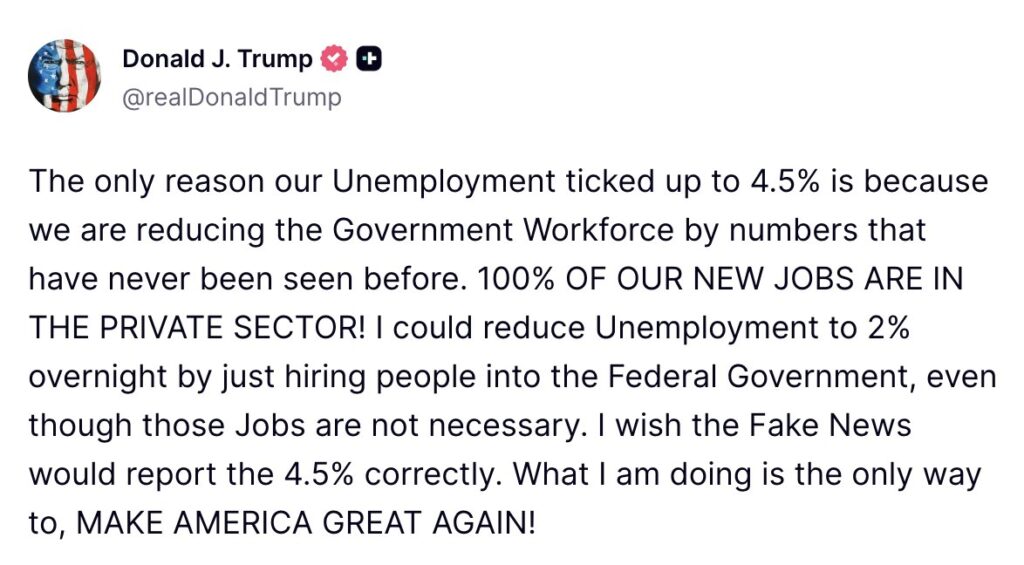
“The only reason unemployment ticked up to 4.5% is because we are reducing the government workforce by numbers that have never been seen before,” Trump said. “This is about efficiency, accountability, and putting America back to work in the private economy.”
The comments come amid heightened scrutiny of the labor market as policymakers, businesses, and voters assess the direction of the economy. While a 4.5% unemployment rate remains low by historical standards, the increase has sparked debate over whether recent economic shifts are temporary adjustments or signs of broader challenges ahead.
Administration officials emphasized that many of the job reductions stem from hiring freezes, buyouts, and the elimination of vacant or redundant positions across multiple federal agencies. Supporters of the policy argue that trimming the federal workforce reduces taxpayer burdens and curbs bureaucratic expansion, allowing resources to be redirected toward national priorities such as infrastructure, defense, and border security.
Economists note that government employment plays a measurable role in overall labor statistics. When public-sector jobs decline rapidly, it can temporarily push unemployment higher, even if private-sector hiring remains steady. Some analysts say Trump’s explanation is plausible in the short term but caution that sustained increases in unemployment would warrant closer examination of private-sector trends.
Critics, however, argue that large-scale government cuts can have ripple effects beyond federal offices, particularly in regions where government employment is a major economic driver. They warn that layoffs and reduced spending could impact contractors, local businesses, and state economies that depend heavily on federal activity.
The White House maintains that the long-term outlook remains strong, pointing to ongoing investment, corporate reshoring efforts, and what it describes as a more disciplined federal government. Trump reiterated that his economic philosophy prioritizes private enterprise over what he has frequently labeled “bloated bureaucracy.”
“Our goal is not bigger government,” Trump said. “Our goal is a stronger, freer economy where the private sector creates real jobs and real opportunity.”
As the debate continues, upcoming labor reports will be closely watched to determine whether unemployment stabilizes as government downsizing continues, or whether broader economic forces begin to influence job growth. For now, the administration is standing firm on its position that the rise in unemployment reflects intentional reform, not economic decline.